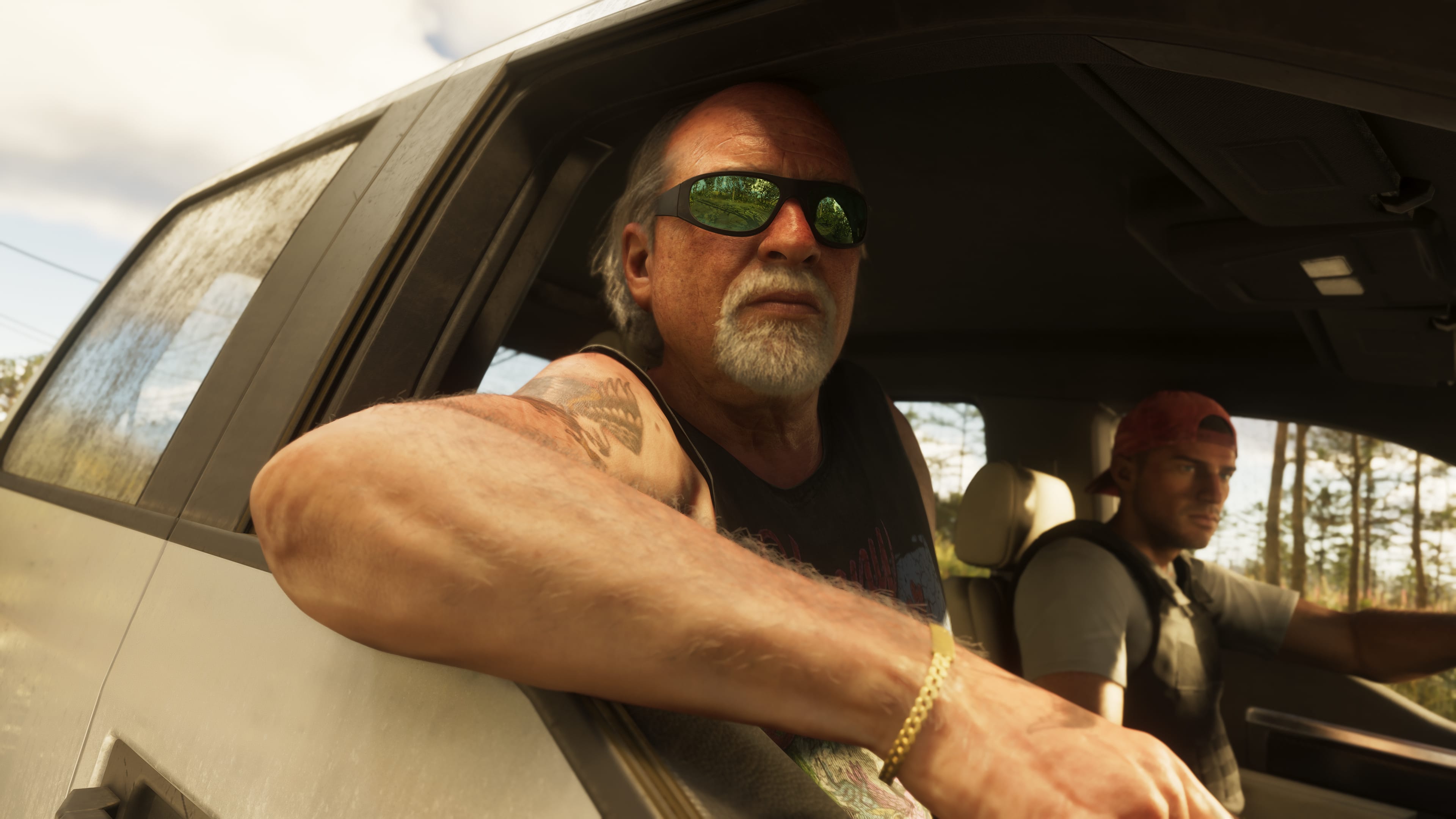
Quick Answer: In GTA 6, like virtually all modern AAA games, character models used during cutscenes are significantly more detailed than those rendered during gameplay. This is a deliberate trade-off to maintain cinematic quality while keeping real-time performance smooth. Rockstar has a long history of pushing this boundary, and GTA 6’s upgraded RAGE 9 engine will likely feature the most sophisticated LOD (Level of Detail) system the studio has ever deployed.
Main Analysis
The Technical Divide: Why Cutscene Models Are Always Superior
A recent Reddit post by user /u/Nearby-Reporter-2077 sparked a conversation about the visible difference between gameplay and cutscene character models in GTA 6. The post, which received over 500 upvotes, noted that the difference is “completely normal” but “interesting” to observe. And indeed, it is a cornerstone of game development—one that Rockstar has refined over two decades.
During real-time gameplay, the engine must render an entire open world, dozens of NPCs, traffic, physics, and dynamic lighting—all within ~16.7ms per frame (for 60 FPS). To achieve this, character models are simplified: fewer polygons, lower-resolution textures, simpler shaders, and coarser animation rigs. Cutscenes, on the other hand, are pre-scripted sequences where the camera is controlled, the environment can be given priority rendering, and models can be swapped for high-fidelity versions with detailed facial rigs, subsurface scattering for skin, and even separate eye and teeth meshes.
Rockstar’s RAGE engine has always handled this transition via a system known as “model swapping.” When a cutscene triggers, the game unloads the gameplay model and loads a dedicated cinematic version. This swap is often invisible to the player because it happens during a camera fade or while the game is preloading the scene. In Red Dead Redemption 2, Rockstar took this to an extreme: Arthur Morgan’s cutscene model used over 150,000 polygons, while his gameplay counterpart was around 50,000—and even that was split into multiple LOD levels as the camera pulled back. GTA 6, built on RAGE 9, is expected to push those numbers even higher, with Lucia and Jason likely sporting over 200,000 polygons in their cinematic forms.
Rockstar’s Historical Approach: From GTA IV to Red Dead Redemption 2
Rockstar has never been satisfied with “good enough” character models. In GTA IV (2008), Niko Bellic’s cutscene model had noticeably sharper facial features and more detailed clothing than his gameplay model, though both were relatively low-poly by today’s standards. The leap came with GTA V (2013), where Michael, Trevor, and Franklin each had unique gameplay models with separate cutscene variants that added finer wrinkles, better hair strands, and more expressive eyes. However, the jump from gameplay to cutscene in GTA V was sometimes jarring—sharp edges on clothes during gameplay became smooth in cinematics.
Red Dead Redemption 2 (2018) was a watershed moment. Rockstar invested heavily in facial capture technology (using 3D scanners and multi-camera arrays) and created separate models for every major character. Arthur Morgan’s cinematic model could display micro-expressions—a subtle twitch of the mouth or a glint of the eye—that were impossible in real-time gameplay because of the sheer computational cost. Rockstar also pioneered “eye shader” technology, where second eyes were rendered differently to simulate human iris dilation, but only in cutscenes. This level of detail is expected to be replicated and improved in GTA 6.
What GTA 6 Could Change: The RAGE 9 Leap
GTA 6 is being developed exclusively for PlayStation 5 and Xbox Series X|S (with a PC release later), both of which feature ultra-fast SSDs and powerful GPUs capable of ray tracing. This hardware leap allows Rockstar to narrow the gap between gameplay and cutscene models. Here are key areas where RAGE 9 might bridge the divide:
- Dynamic LOD streaming: The SSD speeds (approx. 5.5 GB/s on PS5) mean the engine can swap models in milliseconds. Rockstar could potentially use the cutscene model during gameplay when the camera is close (e.g., in first-person mode), only dropping detail when the character is far away.
- Ray-traced reflections and global illumination: While cutscenes have traditionally used baked lighting, RAGE 9 may leverage ray tracing in real-time, making gameplay models look closer to cinematic ones.
- Improved animation blending: Facial animation in cutscenes uses custom bone rigs for lips, eyes, and brows. GTA 6 may extend some of those rigs to gameplay for better reacting NPCs.
However, the fundamental trade-off remains: even with next-gen hardware, open-world games must prioritize performance. Expect the difference to persist, but be less noticeable than in GTA V.
Historical Context
To appreciate how far Rockstar has come, let’s compare the character model detail across past titles:
| Game | Playground Model Polygons (approx.) | Cutscene Model Polygons (approx.) | Notable Cutscene Tech |
|---|---|---|---|
| GTA IV (2008) | 8,000–12,000 | 15,000–20,000 | First use of Euphoria animation in cutscenes |
| GTA V (2013) | 12,000–18,000 | 25,000–35,000 | Separate face and body models; better eye shaders |
| Red Dead Redemption 2 (2018) | 45,000–55,000 | 100,000–150,000 | Full facial capture; micro-expression rig; iris dilation |
| GTA 6 (2026 expected) | 50,000–80,000+ (estimated) | 150,000–250,000+ (estimated) | Likely use of machine-learning upscaled textures; ray-traced skin |
Note: Polygon counts are approximations based on industry analyses and Rockstar’s known practices. Exact numbers are not publicly available.
The table shows a clear trend: Rockstar has doubled or tripled cutscene model fidelity every generation. GTA 6 will likely continue that trajectory, making Lucia and Jason’s cinematic appearances near-photorealistic.
Another important historical point: Rockstar’s Red Dead Redemption 2 proved that high-fidelity cutscene models can coexist with an enormous open world. The game’s Arthur Morgan remained iconic not because of gameplay detail, but because of the emotional weight delivered in cutscenes. GTA 6’s narrative-driven story—reportedly focusing on two protagonists in Vice City—demands the same level of cinematic care.
What This Means / Why This Matters
For players, the distinction between gameplay and cutscene models might seem academic, but it has real implications:
- Immersion: The seamless transition from control to cinematic is crucial. If the swap is too obvious, it breaks immersion. Rockstar has invested heavily in blending these transitions (e.g., using camera fades or dynamic lighting shifts). GTA 6’s fast storage should allow near-instantaneous swaps, making the difference invisible to most players.
- Performance vs. Fidelity: Players who prioritize 60 FPS over graphics may be glad that gameplay models are lighter. Rockstar is expected to offer performance (60 FPS) and fidelity (30 FPS) modes on consoles, with the latter likely using improved gameplay models that approach cutscene quality.
- Modding and Future Proofing: On PC, modders will almost certainly find ways to force cutscene models during gameplay, leading to stunning screenshots but lower framerates. This is a common practice in GTA V and RDR2 mod communities.
- Character Identity: Lucia and Jason must be instantly recognizable whether they are jogging down Vice Beach or delivering a dramatic monologue. Rockstar’s consistent art direction—matching skin tones, hair styles, and clothing between both model sets—ensures this.
Community Reaction
The original Reddit post by u/Nearby-Reporter-2077 received 500+ upvotes and sparked a discussion that reveals fan priorities. Many comments noted that the difference is “normal,” but some expressed hope that GTA 6 would minimize the gap. Others joked that the cutscene model looked like a “movie star” while the gameplay model looked like “a regular person.” The community is acutely aware of Rockstar’s attention to detail and holds them to a higher standard.
On related threads, users are already speculating about the technical capabilities of the RAGE 9 engine. A separate post titled “Rockstar when summer starts” (by u/Great-Juice-9894) humorously demands new trailers, showing impatience for any glimpse of gameplay. Meanwhile, many are waiting to buy a console specifically for GTA 6 (as noted by u/Prestigious_Wait7705), underscoring the game’s role as a hardware seller.
Overall, the community sentiment is one of cautious optimism: they expect top-tier cutscene quality but understand the need for optimized gameplay models. If Rockstar delivers a seamless transition that rivals RDR2, players will be satisfied.
Rumors & Unconfirmed Theories
While the topic of model detail is not driven by leaks, there are related rumors about Rockstar’s technical direction:
- Machine-learning enhanced textures: A leak from 2022 (since debunked by some but partially confirmed by industry insiders) suggested that Rockstar is using AI upscaling to generate 4K textures for characters, potentially allowing gameplay models to use texture resolution previously reserved for cutscenes.
- Neural radiance caching: Another unconfirmed rumor posits that RAGE 9 employs a form of neural rendering to approximate complex skin shading during gameplay, narrowing the gap.
- Facial rig improvements: Some speculate that GTA 6 will employ the same facial muscle simulation used in The Last of Us Part II—a technique where individual muscles move facial geometry dynamically. This would only be possible in cutscenes initially, but may appear in gameplay for protagonist close-ups.
Note: These rumors remain unconfirmed and should be treated as speculation. Rockstar has not commented on any technical specifics beyond marketing materials.
More GTA 6 Guides
- Gameplay Overview – Comprehensive guide to known and rumored gameplay mechanics.
- Characters and Story – Everything we know about Lucia, Jason, and the Vice City narrative.
- Map and Locations – Explore the size and details of the Leonida map.
- Release Info – Current release date, editions, and pre-order details.
Source: Original Article